
Campaign Frame
"Stone does not race."
— Ancient Elven Proverb; Doctrine of Slow Roots.
"Neither does a corpse."
— Imperial Officer Beccin.
Welcome to Eschatia: The Paper Cage
The war did not end with a final stand. There was no glorious charge, no dark lord exploding into light. It ended thirty years ago in a quiet room, with the scratch of a pen on parchment.
You are a citizen of the Elven Republic of Eschatia, a nation that prides itself on patience, magic, and wisdom. But patience has become your prison. The Beccin Empire has arrived, bringing with them steam, iron, and a terrifying urgency. They are choking your culture not with violence, but with permits, schedules, and "modernization."
Look up. The black shapes of Imperial airships blot out the sun.
Listen. The grinding of the train tracks drowns out the birdsong.
Focus. The "Static" in your head screams whenever you try to touch the web.
You are tired. You are watched. You are losing. But today, you received a letter from a dead man. And, maybe, for the first time in thirty years, you are going to do something about it.
How to Use This Guide
This document serves as both the Campaign Frame and the Player’s Guide for our upcoming game. It is the blueprint for the story we are going to tell together.
While the "Handbook" tells you how to play the game mechanically, this document tells you how to play this specific campaign. It bridges the gap between the lore of the world and the stats on your character sheet.
What This Document Provides:
- The Tone: We are aiming for a specific feel—gritty, grounded resistance. This section aligns our expectations so we are all playing the same genre.
- The Reality: Context on the political deadlock, the occupation, and the "Static" that changes how magic works mechanically in this setting.
- Character Roots: Restrictions and prompts to help you build a character who is already embedded in the world, rather than a generic adventurer wandering into town.
- Session Zero Prep: At the end, you will find safety tools and collaborative questions. These must be reviewed before we meet for our first session.
Read this fully before generating your character. In Eschatia, knowing the rules is the only way to break them properly.
I - Core Concepts
The history books call it the Great Armistice. We call it the slow suffocation. Before you build your character, understand the world they are trying to survive in.
The Elevator Pitch: We are playing a campaign about resistance under bureaucracy and occupation. Think Star Wars: Andor meets high fantasy.
The Great War ended thirty years ago. The Elven Republic of Eschatia (The Last Elven State) won the peace but lost the country. We were not conquered by fire or swords, but by papers, treaties, "foreign aid," and bureaucracy.
The Beccin Empire now controls our trade routes, our laws, and our sky. They are building a railroad and telegraph lines through the Sacred Forests to "modernize" us. Meanwhile, a maddening psychic noise known as "The Static" is isolating our people, making magic dangerous and magical communication impossible. The Elven government is paralyzed by tradition, and the Empire is weaponizing that paralysis.
The Atmosphere & Touchstones
- Cynical & Grounded: You are not legendary heroes destined to save the world. You are smugglers, angry farmers, disgraced knights, and tired veterans.
- Paranoia: The Pale Watch (Secret Police) and the Spies of Vardenheim are everywhere. Trust is the most expensive currency.
- Tech vs. Tradition: The Empire brings steam engines, telegraph lines, and rigid schedules. The Elves hold to ancient magic, bloodlines, and the belief that haste is a form of madness.
Media Inspirations
If you want to understand the feeling of this campaign, look to these sources:
- The Politics: Andor (TV). Specifically the visuals of Imperial bureaucracy crushing local culture, and the grittiness of the rebellion.
- The World: Arcane (TV) or Dishonored (Game). The clash of beautiful magic against ugly, jagged industrial pipes and smoke.
- The Despair: Children of Men (Movie). The feeling of a world that is slowly dying while a government pretends everything is fine.
- The Bureaucracy: Brazil (Movie). The horror of paperwork and a state that is maddeningly inefficient.
II - The Three Pillars of the World
Resistance in Eschatia isn't just about fighting soldiers; it's about fighting gravity. Three immense forces press down on the citizens of the Republic, shaping every aspect of daily life.
Resistance in Eschatia isn't just about fighting soldiers; it's about fighting gravity. Three immense forces press down on the citizens of the Republic.
Pillar the First Weaponization of Time (The Doctrine)
The Elven government operates on larger time scale believing that "the fruit must ripen." Constitutionally, legislation proposed in the Spring cannot be voted on until the Autumn.
- The Conflict: The Beccin Empire operates on "Industrial Time." While the Elven Senate spends six months debating the wording of a permit, the Empire builds a factory in a week.
- For the Players: This is why the rebellion exists. You aren’t just fighting the Empire because they are evil; you are fighting because your own government is legally incapable of acting fast enough to save you.
Pillar the Second The Iron Scar (The Occupation)
The physical presence of the occupation is an assault on the senses.
- The Melanoptera (Black Wings): Massive, sleek, black Beccin airships that hang silently over the cities. They block the sun and sit in the air the same way bricks don't.
- The Watchful Eye: You are never truly alone. The Vardenheim Intelligence Service don't just watch you; they quantify you.
- The Railroad: A wound of iron cutting through ancient woods. It brings in cheap Imperial goods and extracts Elven resources.
- The Telegraph: Running alongside the rails, these lines are the nerves of the Empire. If you cut the lines, the beast goes deaf.
Pillar the ThirdThe Psychic Smog (The Static)
While Divination magic has been unreliable for years, the interference intensified six months ago. It is no longer just background radiation; it is a weather system.
The Mechanic: The Psychic Barometer At the start of every in-game day, we roll a 1d12 to determine the local "Noise Level." This dictates how difficult it is to cast spells and how the NPCs around you behave.
The Forecast: The weather carries momentum.
- If yesterday was a Haze (8-10): Add +1d4 to today's roll (The storm builds).
- If yesterday was a Scream/Shroud (11-12): Subtract -1d6 from today's roll (The storm breaks).
Roll | The Weather | Effect on Populace (Flavor) | Effect on Magic (Mechanic) |
1 - 7 | Clear | People are productive. The headache is just a dull throb. | Standard Magic. No penalties. Communication spells work up to 5 miles. |
8 - 10 | Haze | Irritability rises. Migraines are common. Arguments break out easily. | Interference. Casting a spell of Lvl 1+ requires a DC 10 INT/WIS Save. On fail: The slot is not lost, but the action is wasted. Comms limited to 1 mile. |
11 | The Scream | Nosebleeds. Insomnia. Hallucinations of geometry. "Nulls" are viewed with suspicion. | Feedback Loop. Casting Lvl 1+ requires a DC 15 Save. On fail: Spell slot lost + 1 level of Exhaustion. Divination magic must be cast at 2 levels higher. |
12 | The Shroud | Temporary amnesia. The air feels oppressively heavy. Silence. | Null Field. Casting Lvl 1+ requires a DC 20 Save. On fail: Something happens on a modified wild magic surge table. |
- The Isolation: Long-range magic (Sending, Telepathy) has been severed. We are alone in our own heads for the first time in history.
- The Theory: Some say it is somehow connected to the Wizards of the Athenieam, some say it is artificial jamming, and others say it is something related to factories. Whatever it is, all sides have to work around it. It puts people on edge. It erodes trust.
- Some say Wizards or high amounts of magic make it worse the static worse.
III. History
To the Beccin Empire, the last thirty years are a story of benevolent modernization. To us, it is the case file of a murder committed by inches. Here is how we lost.
The Ancient Trunk (c. 4500 – 2000 Years Ago) The Era of Cormanthil. The era the stoneheads won't shut up about. The Elves held dominion over the southern and western continent. This Golden Age ended in the War of the White Silence, a brutal conflict against a Lich-King, Winrich, pushing up from the southern tundras.
- The Victory: We pushed him back to the Glacial, but the cost was absolute. The magical fallout permanently altered the weather patterns in the south.
- The Decline: The war exhausted the high magic reserves. As humans and dwarves began to build nations, the Elves retreated into their forests to recover.
The Silver Throne (2000 – 30 Years Ago) The Era of Eaernthil. The Republic curdled into an Empire, then dissolved back into a paralyzed Republic. This was the era of "Radical Isolation." While the capital flourished, the outer states slowly broke away or were conquered by younger nations, realizing the central government would not save them. We traded territory for solitude.
105 Years Ago: The Night of Fallen Stars. Stars fell and crashed into the southern waters of The Thalassia. Their passing overhead is connected to the births of Aasimar across the lands the stars flew over, including the Last Elven State.
80 Year Ago: The Beccin Empire was formed and started slowly seizing territory around it. The Gilded Nations formed quickly and war ensued, not to protect the nations Bec have taken but to protect themselves. The Last Elven State being close the front lines gave aid, men, and technology to the Gilded Nations.
30 Years Ago: The Great Betrayal (The Armistice) The isolation ended when the war between the Gilded Nations and the Beccin Empire spilled over. Eschatia became the "neutral" buffer state caught in the crossfire.
- The Sacrifice: Eschatia joined the Gilded Nations, granting them military access to defend the continent. We lost 412,315 Elven State citizens holding the line in the mud while the Gilded Nations preserved their own knights.
- The Treaty of Mud: While our soldiers died, the Gilded Nations secretly met with the Beccin Empire. They signed the Armistice without us. Eschatia was not invited to the peace talks. The Athenium took this as a chance to leave, and did so. They left in a single night. While mostly humans, they took 80% of the nation's magical knowledge, the entire aerial defense grid, and the country's strongest markets with them, breaking off to create their own sovereign magi-state. Eschatia was left brain-dead and defenseless. The common people realized that the "Wise Ones" did not care about them.
25 Years Ago: The Velvet Handcuffs (The Slow Coup) The Empire did not invade with soldiers; they arrived with checkbooks. Claiming to help rebuild the damage from the war they started, the Beccin Empire offered massive, low-interest reconstruction loans.
- The Proxenos Arrives: The first Imperial Proxenos was appointed to "advise" on economic restructuring.
- The First Breach: The "Right of Alacrity" (an obscure diplomatic bylaw) was invoked for the first time to bypass environmental protection laws, allowing the first strip mines to open in the Outer Rim (the northern territory near the Ossurian Forges).
15 Years Ago: Gilded Nation currency is banned for government use. Some consider this the real change from being in the middle of two super powers to being on the side of Bec and fully becoming a satellite state.
7 Years Ago: The Fall of Delphi A tear in reality opened near the city of Delphi, unleashing forces from the Shadowfell. Parts of the city were instantly. 1.4 million citizens perished in a day. Many of the High Proxies of the Athenium died. The Athenium tried to rebuild a relationship with Eschatia but they refused. This is the start of the Static, small and quiet. Effecting some of the Divination magics.
5 Years Ago: All divination magics needed to be casted a level higher to prevent getting hit with the Static.
3 Years Ago: The Iron Act The Empire demanded collateral for future projects. The Elven Senate, paralyzed by procedure, capitulated.
- The Surrender: The Empire was granted the rights to build the Trans-Continental Railroad through the Sacred Forests.
- The Traitor: The steam engines were designed by Vaelen Hallow, an Elf traitor working for the Ossurian Forges. His engines utilize a blasphemous blend of mechanics, alchemy, and trapped spirits to run efficiently.
- The Static starts affecting people in some area all at once, regardless if they are using magic. It is like the weather but only effecting people some days of year.
6 Months Ago: The Silence The "Static" intensified from a hum to a scream. Long-range magic (Sending, Telepathy, Scrying) shattered.
- The Disconnect: The provinces are now cut off from the capital. We hear only mail can carry, word of mouth, what what the Empire allows to pass through the telegraph wires.
- The Symptom: Mages attempting to cast through the Static report nosebleeds and visions of "grey geometry."
Present Day The Rails are running. And today, you received a letter from a dead man.
IV. The State of the State
Eschatia is not a dictatorship; it is a democracy that has been weaponized against itself. The machinery of state still turns, but the gears grind.
To survive, you must understand that the Occupation did not break our laws—it simply found the loopholes.
Ancient Traditions: The Doctrine of Slow Roots
Every government has core philosophies and Eschetia is no exception. The Republic is built on the philosophy that "Stone Does Not Race." The Constitution (The Charter of Marble) was written by Ancient elves who feared rash emotion taking hold, like how their empire fell to rash emotion.
- The Seasonal Delay: Constitutionally, no law or major decree can be voted upon in the same season it is introduced. A bill proposed in Spring cannot be ratified until Summer.
- The Intent: To ensure the "fruit ripens" and the populace has months to debate.
- The Reality: In the face of an industrial Empire that builds a factory in a week, this rule is a death sentence. The Elven government is legally incapable of reacting fast enough to save its own citizens.
Branches of Federal Government
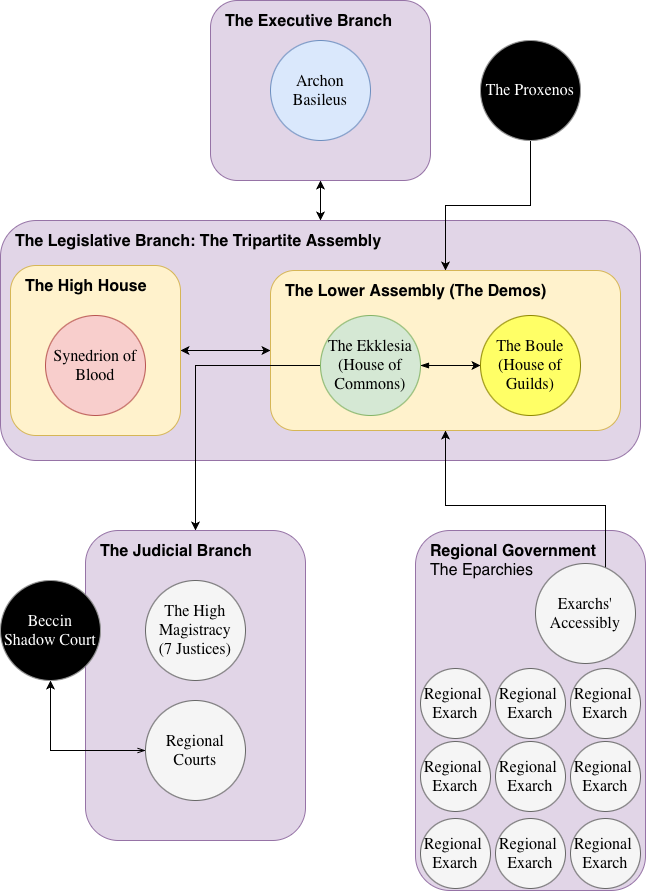
The government is a Tripartite Assembly designed to prevent any single faction from holding power. In practice, it ensures no one holds power at all.
The Executive: The Archon Basileus
The Head of State serves a single 10-year term. They ceremonially wear the "Diadem of Burden," a magical artifact said to grow physically heavier with the people's sorrow. This is a leftover from when the Elven government was a empire.
The current Archon, Basileus Aethelgard IV, has not been seen publicly in 3 years. They have made appearances in private events, enough to be reported on. Rumor has it they no longer wear the Diadem, as the weight would snap their neck. They are widely considered a figurehead.
The Legislative: The Deadlock
Legislation must survive two distinct houses, usually dying in committee before ever reaching a vote. The houses are often called the higher and lower houses, with the lower house holding two chambers. The upper house is often seen as ceremonial and a way of these old eleven bloodlines, from the time of Cormanthil, to maintain power and relevance.
- The Synedrion (High House): Composed of the Patriarchs and Matriarchs of the 12 Great Sorcerer Houses. They hold "Divine Veto" power and sit in the Sky-Oculus. They are obsessed with bloodline purity and holding onto state secrets. They have become to paranoid they have not held a public form in nearly 10 years.
- The Ekklesia (Chamber of Commons): 112 representatives elected by geography. They manage civil liberties and social law. They possess the "Veto of Conscience," which allows them to pull on the heartstrings of tradition and philosophy. Most of the laws of the land are generated in this chamber, few are ever vetoed. This chamber also has the right to veto the other lower chamber, it has tried to do so far more often.
- The Boule (Chamber of Guilds): 253 Guildmasters appointed by profession. They control the trade tariffs and regulation around banking, trades, and crafts. There is growing tension between them and the Chamber of Commons as they see that chamber difficult and impractical. While the Chamber of Commons mostly allows the Gamber of Guilds to regulate things regarding beef grading or metal purity they Chamber of Commons shoots down a lot of purposed funding for things like the railway.
The Judiciary: The Broken Scales
Seven Justiciars appointed for life. They preside over Elven civil law. A standard trial takes 1 to 10 years. While the Seven are appointed by the lower house and approved by the upper house the lower courts are appointed by the seven and confirmed by the lower house. Along side the elven courts are the Imperial Circuit, which is almost too fast and for anything that "could be related to the empire." It was orginally impimented 15 years ago to help remove the burden of the empire on the courts for crimes commited against them. If you steal bread from an Elf, you face a jury of your peers next season. If you steal coal from the Beccin Railroad, you face the Circuit today, and you are gone by sundown.
Regional Governance: The Eparchies
The nation is divided into administrative regions called Eparchies. They are ruled by Exarchs (Governors) selected via the Dual Mandate System:
- The regional council selects 3 candidates.
- The people vote for 1.
The Beccin Empire now pressures regional councils to nominate only three sympathetic collaborators. The voters are given a "choice" between three different flavors of Imperial puppet.
How Bec Got In: The Proxenos & The Loophole
The Beccin Empire did not conquer the capital; they were invited in.
The role of Proxenos (Ambassador) was created centuries ago, in Cormanthil, to represent "short-lived races" (Humans/Dwarves) in the Elven court. To bridge the gap between Elven "Slow Roots" and Human mortality, the Proxenos was granted a specific emergency power: The Right of Alacrity. This Right allows the Proxenos to bypass the Seasonal Delay and force an immediate vote on matters of International Security, Trade, Policy, or Unrest. This right is never codified in ink anywhere and for years has rarely exploited to this degree. The current Proxenos is Imperial Legate Kaelus. He uses this right daily. While the Elven Senate waits six months to vote on a parkour permit, Kaelus forces through "Emergency Railroad Acts" and "resource extraction permits" in a single afternoon.
Veto Flow
- Commons proposes a law.
- Guilds can delay it for "Economic Review" (Indefinitely).
- Sorcerers can veto it for "Security Concerns" (Immediate).
- The Empire bribes the Guilds to delay everything except what they want.
The Shadow State: The Iron Duchy of Vardenheim
While the Proxenos handles the paperwork in the capital, the enforcement comes from the northwest. To the uninitiated, Vardenheim is merely a Beccin vassal state—a windswept frontier of hardy folk providing iron and conscripts to the Imperial Army. This is a cover story. Vardenheim is the Empire’s nervous system.
- The Surveillance Hub: The Duchy processes the intelligence gathered by the telegraph lines. Every dissenting telegram, every suspicious withdrawal from the bank, and every flagged magical signature is routed to the grim citadels of the Varden steppes for analysis.
- The Black Labs: Vardenheim has become the premier site for "Forbidden Research." It is an open secret that the Duke sanctions experiments on live subjects.
- Demographics of Control: Unlike the diverse Republic, Vardenheim is rigidly structured: 88% Beccin Human, 8% Indentured Dwarven Smiths (for the war effort), and 4% "Sanctioned" Mages used as living radar arrays.
V. The Economy of Occupation
If the Pale Watch breaks your spirit, the Rublok breaks your wallet.
To control the economy, the Beccin Empire has outlawed the use of foreign currency in official transactions. The "Gilded Coin" (Standard GP/SP/CP) used by the Gilded Nations and the old Elven Republic has been deemed "unstable." It is now contraband. If you want to buy a train ticket, pay your taxes, or purchase goods from an Imperial commissary, you must use the Rublok.
The Base-3 Nightmare The Rublok is not based on the weight of gold. It is a fiat currency ("Imperial Notes") backed by the industrial output of the Empire. To further confuse the Elven populace and sever ties to tradition, it utilizes a strict Base-3 system.
There are no "Tens" or "Hundreds." There is only the Power of Three.
Coin/Note | Value | Street Nickname |
The Trium | 27 Rubloks | "A Brick" |
The Nineum | 9 Rubloks | "A Square" |
The Threen | 3 Rubloks | "A Triangle" |
The Rublok | 1 Rublok | "A Standard" |
The Third | 1/3 Rublok | "A Shard" |
The Ninth | 1/9 Rublok | "Gravel" |
A night at an Inn is around 3 Rublok + 1 Third, Inn Meal 1 Rublok + 1 Third, Fine Wine 3 Threen, Normal Wine 2 Thirds, Ale 1 Third, and Bread 1 Nineth.
Mechanics of Exchange:
- The Exchange Rate: The Empire sets the rate arbitrarily. Currently, 1 Gold Piece (Gilded) ≈ 3 Rubloks. However, if you are caught paying with Gold in a government building, the money is confiscated.
- The Black Market: The Resistance, smugglers, and old families still trade in Gilded Coins (Gold/Silver/Copper). Wolgari Port Shillings are accepted but rarely found. Gold holds value; Rubloks only hold value as long as the Empire stands.
- For your Character Sheet: We will track wealth in Rubloks. If you possess Gold, record it as a "Valuable Item" rather than liquid cash, as it is difficult to spend openly.
The "Math Tax" Shopkeepers are required by law to round prices up to the nearest Base-3 denomination. This often results in the Elven poor losing value on every transaction, a phenomenon bitterly referred to as the "Math Tax."
VI. The Handler
Name: Aelion Thorne (known to the Registry as Archivist Grade-4; known to you as "The Clerk").
Race: High Elf (Eschatian).
Appearance: Unassuming. Always wears the grey woolen robes of the Civil Service. Ink stains on his cuffs. Spectacles that reflect the gaslight, hiding his eyes. He looks like a man who has spent thirty years staring at tax forms.
The Public Face To the Empire and the Republic, Aelion is a piece of furniture. He is a fixture in the Hall of Records, specifically in the Department of Retroactive Compliance. He is the man who stamps the forms that allow the Empire to seize land for the railway. He is boring, efficient, and invisible.
The Private Reality Aelion is the architect of the resistance. He realized decades ago that you cannot fight the Empire with swords, because they have more soldiers. You cannot fight them with magic, because of the Static. You must fight them with their own weight. He utilizes "The Error"—a philosophy of resistance that involves misfiling arrest warrants, losing evidence, "accidentally" approving supply drops for rebels, and changing a single digit on a coordinate to send an Imperial train to the wrong depot.
The Web of Ink (Why You Are Here) You are not a team yet; you are a collection of loose ends that Aelion tied together. Every one of you know him in some way. In some part of your life the Clerk intervened. It might have been he found supplies for your group to fight, or made sure your pension paperwork was filled out to get you more pay. He bought your lives with his paperwork. He is the hub that all you, the spokes, connect to for the start of this.
The Current Status Yesterday, Aelion Thorne did not show up for his shift at the Hall of Records. At noon, the Pale Watch kicked in the door of his apartment. They found it empty, save for a warm cup of tea and a smell of ozone. At sunset, you received the letter. The Clerk is gone. The hub has collapsed. And he has left you with are vague clues of the morning and that you must fight.
VII. A Draft of the Indicting Incident
This section will change a lot prior to the first session, consider this inspiration for the style of game this could be.
Punctuality is the courtesy of kings. Survival is the courtesy of the desperate.
The Trigger: The Dead Letter The game begins not in a tavern, but in the rain. Current Static Level: Haze (Roll: 9). Casting spells will be difficult today; anyone attempting a Level 1+ spell must make a DC 10 Save or lose the action. Each of you received a letter via pneumatic tube or courier this morning. It contained no words, only a heavy iron key and a coordinate: Terminal 4, Locker 912.
The Scene: Union Station You stand in the shadow of the Imperial departure boards. The station is crowded with Beccin soldiers and tired Elven workers. You do not know each other yet, but you all recognize the look of someone waiting for a ghost.
The Event: The Locker When the locker is opened, it is empty save for a single, small slate tablet and a terrifyingly large amount of Imperial money. As you touch the tablet, a pre-recorded illusion flickers to life—distorted by the Static, grainy and grey. It is Aelion Thorne. He looks tired.
If you are seeing this, the math finally caught up with me. I have been audited. You are the variables I left off the books. Do not look for me. Look for the 'Solstice Train.' It leaves in ten minutes. It carries the one thing the Empire cannot account for. You have the money for tickets. Get on the train. Survive the trip. Find the Architect.
The Objective (Session 1): You are strangers holding a burning beacon. You have 10 minutes to navigate a locked-down station, bypass the checkpoints, and board the Solstice Train before it departs for the Outer Rim. If you miss the train, the rebellion ends before it starts.
VIII. Safty Lines and Veils
"We wear armor so we can fight harder. We use safety tools so we can play deeper."
Eschatia is defined by oppression, paranoia, and the slow erasure of a culture. We are going to explore dark themes: a police state, racism (fantasy), and the toll of occupation. Because we are playing with heavy subjects, we need strict boundaries to ensure everyone at the table is having fun, even when their characters are miserable.
We will use the Lines and Veils system.
- A Line: A hard boundary. We do not cross it. It does not exist in our game world.
- A Veil: A soft boundary. It happens in the world, but we "fade to black" or handle it off-screen. We do not describe the details.
The Baseline (Standard Table Rules)
These are the defaults for this campaign. We can change things as things go.
- LINE (No Go): Sexual violence (non-consensual sexual content), harm to children, and real-world slurs/hate speech.
- VEIL (Fade to Black): Extreme torture, consensual romance/sex scenes.
The "Eschatia" Specifics (Thematic Calibrations)
Because of the specific nature of The Paper Cage, we need to align on the following during Session Zero:
1. Fantasy Racism vs. Real Discomfort The story is about the Beccin Empire oppressing the Elves. "Knife-ear" and other in-world slurs will likely be used by villains to establish them as antagonists.
- The Discussion: Are we comfortable with in-character bigotry as a plot point? Where is the line between "gritty atmosphere" and "uncomfortable for the player"?
2. The Static & Mental Health The "Static" mechanic simulates mental intrusion, hearing voices, and the loss of reality.
- The Discussion: This mimics symptoms of real-world mental health struggles (dissociation, schizophrenia, sensory overload). We need to ensure our descriptions of "magical madness" remain respectful and do not mock real-world conditions.
3. Police Brutality & Gaslighting The Pale Watch uses bureaucracy as a weapon. Characters may be arrested for crimes they didn't commit, interrogated, or gaslit by authority figures.
- The Discussion: How much detail do we want in interrogation scenes? Do we play them out, or do we roll dice to see the result?
4. Player vs. Player (PvP) The setting relies on paranoia. "Trust is the most expensive currency."
- The Discussion: Are players allowed to betray each other? Or is the "Cell" sacrosanct?
- Recommended: The characters can mistrust each other, but the players must cooperate. No stealing from or killing party members without out-of-character consent.
- We can have both open and closed secrets.
IX. PC Gen
To survive the occupation, you must be forged, not chosen. We do not use Point Buy. We do not use the Standard Array.
Step 1: The Ritual of Six This process must be done during Session Zero, at the table, in full view of the group. You must use the specific set of Metal D6s provided by the GM.
- Roll 4d6. Discard the lowest die. Record the total.
- Repeat this process seven times.
- You now have seven numbers. Drop the lowest number.
- Assign the remaining six numbers to your Ability Scores as you see fit.
Step 2: Hit Points
- Wizards: Due to the strain of the Static, Wizards use 1d4 for their Hit Die (instead of 1d6).
- All Other Classes: Standard PHB Hit Dice.
- Hit Points at Level 1: Max possible for your die type + CON modifier.
Communications in Classes
- Warlocks: If communication is cut, does a Warlock lose contact with their Patron?
- Clerics/Paladins: Does the Static block divine intervention?
- Sorcerers: Do they suffer the same penalties as Wizards?
X. Protocols of Speech
In Eschatia, there is no "Common" tongue. If you cannot speak to the guard, you cannot bribe the guard. If you cannot read the ancient warnings, you cannot survive the ruins.
We are replacing the standard Language rules with a Fluency System.
Fluency Levels
- None: No comprehension.
- Basic (Phrasebook): Simple greetings and rudimentary instructions. Relies on gestures.
- Conversational: Comfortable in everyday dialogue. Can barter and navigate. Struggles with complex politics or science.
- Fluent: Near-native. Understands idioms and nuance. Reads and writes proficiently.
- Academic/Native: Mastery. Understands dialects, archaic forms, and deep cultural context.
Starting Languages
- Origin: You are Fluent in the primary language of your homeland.
- Background: Grants one additional language at Fluent.
- Class/Race: Specific features (Druidic, Dwarven) grant Fluency.
Language Families If you are Fluent in a language, you have Basic understanding of related languages in the same family (or Advantage on INT checks to decipher them).
Languages of the World The "Real-World Analog" indicates the sound, accent, or script style for roleplay purposes.
Language | Origin/Speakers | Script | Real-World Analog |
Modern Elvish | The Republic of Eschatia | Elven | Welsh / Gaelic |
Beccin | The Beccin Empire | Cyrillic | Russian |
Haroldian | The Gilded Nations | Latin | UK English |
Arfordirian | Arfordir | Latin | French |
Common Delphic | The Athenaeum (Mages) | Classical | Modern Greek |
Cavosian | Common Dwarven | Runes | Finnish |
Ironic | Iron Bash Dwarves | Runes | Latvian |
Auran | Icebeach Dwarves | Runes | Estonian |
Ikbesh | Icebeach Humans | Common | Norwegian |
Astrousian | Astrousia Trade Tongue | Latin | Old Nubian |
Golith | Nomadic Giant Tribes | None/Latin | Sami / Kalmyk |
Language | Origin | Script | Real-World Analog |
Arcana | High Academic Magic | Arcana | Latin |
Draconic | Kobolds/Dragons | Draconic | German |
Celestial | Higher Planes | Celestial | Welsh |
Aethonix | Ancient Giant Ruins | Glyphs | Sumerian/Cuneiform |
Winthrex | Cults of the Lich-King Winrich | Ikbesh | Coptic |
Infernal | The Hells | Infernal | Mandaic |
XI. Lingo of the Setting
When the walls have ears and the air itself swallows magic, words become weapons. To sound like a local, you need to know how to speak in the shadows.
- Tickers: A derogatory term for Humans or Beccin officials. Used to mock their short lifespans and their obsession with schedules/efficiency. (e.g., "Don't mind him, he's just a ticker. He’ll be dead before the law passes.")
- Kindling: A cruel slur for Elven collaborators who work for the Empire. The implication is that they are burning themselves up to keep the Imperial machine warm.
- "Going North": A euphemism for being disappeared by the secret police. (e.g., "I haven't seen the baker in a week, I think he went North.")
- Iron-Eyes: Slang for a Vardenheim spy, referring to their lack of emotion and the local legend that they replace their eyes with lenses.
- Under Review: A phrase used to describe someone who has been arrested. (e.g., "Where is your father?" "He is currently under review.")
- Off-Ledger: Anything illegal or undocumented. People don't exist "underground," they exist "off-ledger."
- The Wind: Bad news or rumors of a raid. (Referring to the winds of the Varden steppes).
- Clear-Heads: Slang for days when the Static roll is 1-7. Also used to describe people who are unusually resistant to the noise.
- The Stitch: The railroad tracks. Called this because they look like black sutures holding the wounded earth together.
- Paying the Salt: Paying a bribe. (Derived from the old Imperial salt tax).
- Nulls: People who are not affected by the static.
- Geometry: Slang for a Level 11 "Scream" day, referring to the hallucinations. (e.g., "Keep your head down, I'm seeing geometry today.")
- The Fizz: The sound/feeling of a spell failing due to interference.
- Shroud-blind: The state of amnesia or confusion caused by a Level 12 day.
- Triangles: Slang for money in general, referring to the three-sided nature of the Rublok system.
- Heavy Money: Gilded Coins or Dwarven Anvil Marks. Real metal currency, illegal but valuable.
- Paper-Rich: Someone who has a lot of Rubloks but no actual assets. (e.g., "He's paper-rich, wait until the inflation hits.")
XII. Collabtion Questions of the Setting
A party formed in a tavern is a cliché. A cell formed by necessity is a bond. Let’s establish the threads that tie you to the world, and to the dead man who brought you here.
Do not answer all of these.
- Pick 1 from "The Clerk." (Required)
- Pick 1 from "The Static." (Required)
- Pick 2 others from any category.
A. The Clerk (Aelion Thorne)
He was a boring man who saved your life with a pen stroke. How?
- The Mistake: You committed a crime five years ago that should have sent you to the mines. The paperwork for your arrest was "lost" in transit. How did you find out Aelion was the one who lost it?
- The Pension: You are living off a government stipend or veteran's pension you don’t technically qualify for. Aelion approved it. What do you use that money for?
- The Identity: You are not who your papers say you are. Aelion provided you with a new identity (birth certificate, work permit) after you had to flee your home. Who/What are you hiding from?
- The Warning: You were on a list to be "questioned" by the Vardenheim spies. Aelion sent you a coded message telling you not to go home that night. What did you see when you went back the next morning? Why did they want to question you?
- The Heirloom: The Empire seizes magical artifacts. Aelion intercepted a family heirloom of yours before it was melted down and returned it to you wrapped in a ledger page. What is the item?
- The Bloom: Aelion didn't save you; he saved something you care about (a park, a shrine, a specific tree) from being bulldozed for the railway by delaying the permit for three years. Why does that place matter to you?
B. The Static (Psychic Fallout)
The psychic noise affects everyone. How does it manifest in you?
- The Sound: It isn’t just white noise to you. When you try to focus or touch the web (magic), what specific sound do you hear? (e.g., Grinding gears, a child screaming, the ocean, buzzing bees).
- The Phantom: When the Static is at its worst, you hallucinate a specific figure in the corner of your vision. Who or what is it?
- The Tell: On a "Haze" day, irritability rises. What is your specific physical tell that the pressure is getting to you? (e.g., trembling hands, bleeding gums, aphasia).
- The Migraine: You have a physical "tell" when the Static spikes. Do your hands shake? do your eyes bleed? Do you lose the ability to speak?
- The Coping Mechanism: The only way to silence the noise is a vice. Do you smoke "Greyleaf"? Do you drink industrial spirits? Do you engage in pain/self-harm to ground yourself?
- The Null: You are one of the rare few who feel nothing. The Static doesn't hurt you. How do others find this suspicious?
- The Signal: You are convinced the Static isn't just noise—it’s a code. You have a notebook full of nonsense you’ve written down while listening to it. What do you think it is trying to say?
- The Breaker (The Shroud): On a "Shroud" day (Roll 12), you suffer temporary amnesia. What is the one thing you are terrified you will forget? (e.g., Your mother's face, the location of the safehouse, your own name).
C. The Occupation (Life Under Iron)
The Beccin Empire has been here for 30 years. How have you survived?
- The Collaborator: You didn't always fight. You held a job working for the Empire (building the tracks, clerking, cooking for soldiers). Why did you quit? Or were you fired?
- The Displaced: Your childhood home no longer exists. What stands there now? (A factory, a statue of a General, a crater?)
- The Little Rebellion: You have been committing a petty crime for years that hurts the Empire in a tiny way. (e.g., You loosen bolts on park benches, you steal coal, you mislabel grain shipments). What is it?
- The Language: You speak Beccin fluently. Did you learn it to survive, or were you forced to learn it in a "re-education" school?
- The Token: You carry a physical permit that allows you to do something normal people can't (Walk on the upper streets, carry a dagger, cast cantrips, inspect shipments). What did you do to earn this privilege?
- The Scar: You have a physical mark left by Imperial machinery or Imperial soldiers. Is it a burn? A brand? A missing finger?
D. The Past (The War & Armistice)
The war ended 30 years ago. Where were you?
- The Veteran: You fought in the trenches before the surrender. You have a weapon from that time hidden under your floorboards. What is it?
- The Orphan: You are too young to remember the war, but you were raised by someone who never stopped fighting it. What lie were you told about your parents?
- The Betrayal: You blamed the Elven Senate for the surrender. You once protested in the streets. What happened to the people who protested with you?
- The Outsider: You aren't from Eschatia or Beccin. You came here for work or refuge and got trapped when the borders tightened. Where is home?
E. The Cell (Inter-Party Relationships)
Select at least one other Player Character (PC) for each.
- The Secret: This PC knows you are wanted for a crime you didn't commit (or one you did). Why haven't they turned you in?
- The Shared Grief: You both lost someone in the War. Do you talk about it, or is it a silent understanding?
- The Friction: You think this PC is too reckless (or too cowardly). You argued about it recently. What was the argument about?
- The Debt: You owe this PC a significant amount of money. What did you borrow it for?
- The Witness: This PC saw you during a moment of weakness (a Static episode, a breakdown, a moment of cowardice). They helped you back up.
- The Suspect: You aren't 100% sure this PC isn't a spy. There is one detail about their story that doesn't add up. What is it?
F. Moral Grey Zones (Noir Elements)
This is a game about hard choices.
- The Bribe: You regularly pay off a member of the Pale Watch to look the other way regarding your business. Who is it?
- The Prejudice: You have a hard time trusting a specific species (Half-Elf, Dwarf, or High Elf) due to the war. Which one and why?
- The Line: There is one thing you will never do for the rebellion. (e.g., Harm a child, use dark magic, betray a family member). What is your hard line?
- The Informant: You once gave information to the Empire to save your own skin. No one knows. Who got hurt because of what you said?
XIII. The Chronicler's Reward (H.A.G. Rule)
History is written by the victors. The Empire burns our books so they can write the future. We must keep our own records, off-ledger, if we want to survive.
This rule rewards players who contribute to the campaign's "Archives."
The Mechanic After a game session, a player may choose to produce a detailed written account (Field Report) of the exploits. If this chronicle is shared with the party (via Discord/Wiki) before the next session, the character finds a Cache of Supplies (functionally a Potion of Healing or equivalent coin/materials) in their gear.
The Criteria To gain the requisition, the report must include:
- Timeline: In-game dates.
- Significant Moments: Two pivotal decisions or turning points.
- Intel: New lore, secrets, or "Static" observations.
- Persons of Interest: NPCs encountered.
- Asset Log: Loot and items acquired.
Note: If multiple players contribute reports, they all receive the reward. Even just submitting notes will earn you this, summarizing the campaign thus far as a recap at the top of a session, and so on.